Acquiring a new customer costs 5 to 25 times more than keeping an existing one, according to Shopify's 2026 Ecommerce Customer Retention guide. Yet an analysis of more than 156,000 direct-to-consumer customers found an average repeat purchase rate of just 18.8%. That means more than 80% of buyers never place a second order. When you want to increase customer lifetime value on Shopify, you need a system that bridges the gap between the first and second purchase.
Most brands just blast the same 20% off code across every channel. That burns out the list and trains people to ignore you. Effective LTV marketing means dividing the work. We build programs where automated flows carry the majority of the revenue, using each platform for what it does best.
How to split the job between email and SMS
The core reason brands suffer from high unsubscribe rates is treating text messages like a shorter version of their newsletter. Each channel has a distinct structural role in the buying journey.
The role of email in growing lifetime value
Email carries the heavy lifting of education, brand storytelling, and detailed product recommendations. It gives you the bandwidth for multi-block HTML layouts, dynamic product feeds from your Shopify catalog, and detailed setup instructions.
Shoppers check their inbox asynchronously. This gives them time to read a care guide or compare accessories. Because there is no per-message telecom fee, email is the ideal workhorse for multi-step onboarding, cross-selling, and long-tail winback sequences.
The role of SMS in driving immediate action
Text messages interrupt the buyer in real time. Tolerance for fluff is zero. SMS handles time-sensitive drops, high-intent cart reminders, and tight reorder nudges.
According to Klaviyo's 2026 SMS Benchmarks, automated text flows drive 45.2% of total SMS revenue despite making up only 7.6% of sends. When you text a buyer exactly when a consumable runs out, it feels like a helpful service rather than an ad. If you send too many promotional texts, your unsubscribe rate will climb past the 2% that Klaviyo recommends staying under.
Which automated flows turn a first-time buyer into a repeat customer?
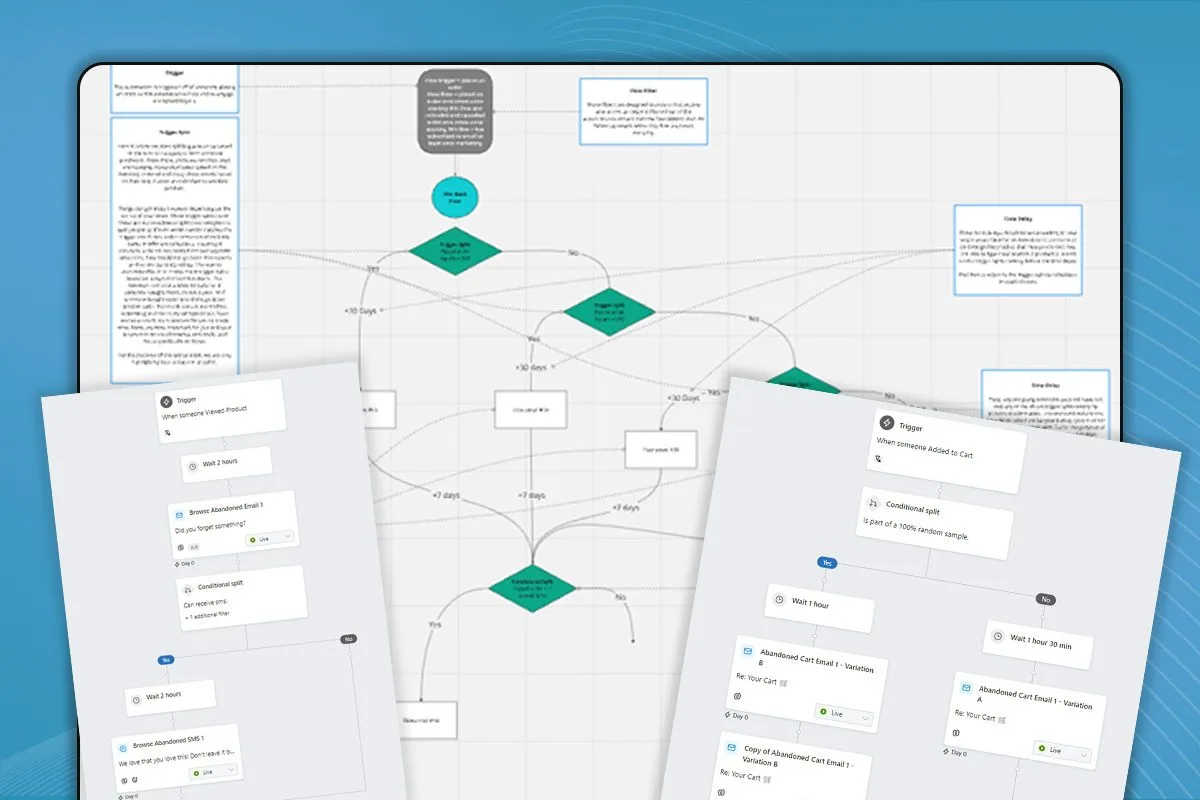
Growing Shopify lifetime value depends on four connected lifecycle automations. These paths move a buyer from their first checkout to their second and third orders.
Post-purchase education and onboarding
A Klaviyo post-purchase flow that only sends a shipping receipt leaves money on the table. The post-purchase window carries the heaviest retention workload. If buyers do not know how to assemble, care for, or get results from their first order, they will never buy again.
Split first-time buyers from repeat customers in your automation. Send first-timers a founder thank-you note on day one. Follow up a few days after delivery with a product care guide or setup video tailored to the exact collection they purchased. Save the VIP recognition for repeat buyers.
Post-purchase cross-sell
Once the customer experiences the initial item, introduce natural companions without discounting the entire store. Trigger this flow based on a fulfilled order after 14 to 21 days. Filter out anyone who has placed an order since starting the flow.
If a customer bought a core product like an electric bike, suppress that core item and showcase high-margin accessories like pannier bags or extra batteries. Use email to show visual pairings and customer reviews. If they open the email but do not buy, send a single text reminder before a bounce-back credit expires.
Replenishment timing for consumables
For supplements, skincare, pet food, and coffee, customers churn because they simply forget to reorder before running out. Set your trigger for a placed order of a consumable item. Set the time delay to the average consumption window minus shipping time. For a 30-day supply with three-day shipping, trigger the flow on day 23.
Send an email showing the exact item they bought with a one-click reorder button. If they do not place an order, send a tight text message on day 26 linking straight to a pre-filled checkout. Because the timing matches their exact need, click rates stay high.
Winback timing before buyers go cold
Most brands fire a Klaviyo winback flow at a generic 90 days. That timing is where brands often go wrong. A supplement buyer goes cold at day 45, while a furniture buyer is still within a normal cycle at day 90. Trigger your sequence at one and a half to two times your average time between orders.
Start with an email showcasing what is new since their last order. Wait five to seven days and introduce a tiered incentive like a free gift with purchase. If they have opted into texts, use a final urgency nudge before the offer expires. If they still ignore it, transition them cleanly out of active campaign segments.
Why segmentation stops list fatigue
Blasting the entire list with every campaign destroys sender reputation at Gmail and Yahoo. It also inflates carrier costs and creates immediate buyer regret. If a customer places their first order on Tuesday, receiving a sitewide 20% off promotional email on Wednesday guarantees a support ticket.
Stop fatigue by separating recent buyers from unengaged subscribers. Create dynamic segments that exclude anyone who bought in the last 14 days from standard promotional blasts. This lets your post-purchase flow educate them without interruption.
Next, build engagement tracks. Send frequent campaigns only to people who have opened or clicked recently. On the text side, keep unsubscribe rates low by tracking engagement and staggering your sending. Rather than firing an email and a text at the exact same hour inside an abandoned cart flow, space them out by 12 to 24 hours to see if the customer already bought from the first message.
What this looks like in practice
Two 90-day builds show how much of the work flows can carry.
When we rebuilt every flow for Biktrix, we generated $140,401 from email and SMS in 90 days. Automated flows drove $82,602 of that total. That represents 58.8% of their total program revenue and lifted the channel to 35.2% of store revenue.
For an anonymous DTC furniture brand, we built the system from scratch. In the first 90 days, we generated $113,614. Flows generated $97,212 of that total. That means 85.6% of the revenue came from 11 live flows alongside 22 email campaigns and just two text campaigns.
Building customer lifetime value takes time, but the math works when you have the right infrastructure. If your flows are leaky and your campaigns are guesswork, start there. Fix the automations that already have demand baked in, then build a calendar you can stick to.