Flows are where most of the money in ecommerce email comes from. Campaigns bring in the spikes, but flows run every hour of every day, to the right person, at the right moment, without anyone pressing send. In a healthy Klaviyo account they usually make up somewhere between a third and half of email revenue, and in accounts we audit they are also where most of the lost revenue is hiding.
This guide is the map. It covers the flows every ecommerce brand needs, the order I build them in, how each one should be structured, and how to keep them performing once they are live. Each section links to the detailed walkthrough for that flow, so you can read this top to bottom or jump straight to the one you are building today.
The six core flows
If you only build six flows, build these. They cover the whole customer journey: someone signs up, looks around, nearly buys, buys, and either comes back or drifts away.
- Welcome series for new subscribers who have not bought yet.
- Browse abandonment for people who looked at products and left.
- Abandoned cart and abandoned checkout for people who got close to buying.
- Post-purchase for first-time customers, to turn one order into two.
- Win-back for customers who have gone quiet.
- Sunset for subscribers who have stopped engaging, to protect your deliverability.
I go through why these six and what each one is for in The 6 Core Klaviyo Flows Every Ecommerce Brand Needs, and the version of the same list for larger stores in The Six Email Automations That Scale Brands Past $100K a Month. If you are on Omnisend rather than Klaviyo, the logic is identical: see The Core Automations You Need to Build in Omnisend.
What order to build them in
Build the flows closest to the money first. That means abandoned checkout, then abandoned cart, then welcome, then post-purchase, then browse abandonment, then win-back and sunset. A checkout abandoner has already typed in their email and nearly paid, so that flow pays for itself in days. A sunset flow saves you money and protects your sender reputation, but it will not show up as revenue, so it tends to get built last. Build it anyway.
If you are replacing flows that already exist, do not switch them off and turn the new ones on in the same minute. There is a clean way to hand over from old to new without dropping people mid-sequence, which I cover in How to Transition from Old to New Flows in Klaviyo.
Welcome series
The welcome series is the first impression and, for most brands, the highest-converting flow in the account. The mistake I see most often is treating it as one email with a discount code. The brands that do well run a sequence: an immediate email that delivers the offer, then a handful of emails over the following week or two that tell the story, show the best sellers, bring in social proof and remind people the offer is running out.
How to build it from scratch, including the structure I use for larger stores: How to Build a High-Converting Klaviyo Welcome Series.
If your welcome series is live but underperforming, read Why Your Welcome Series Isn't Driving the Sales You Think before you rebuild anything. Two more useful reads: a teardown of a brand that gets it right in What Drunk Elephant Gets Right in Their Welcome Series, and a way to keep the sequence growing without writing from scratch in How to Turn Winning Campaigns into an Extended Welcome Flow. When it is time to write the emails, I use the prompts in How to Script Your Welcome Series with ChatGPT.
Abandonment flows
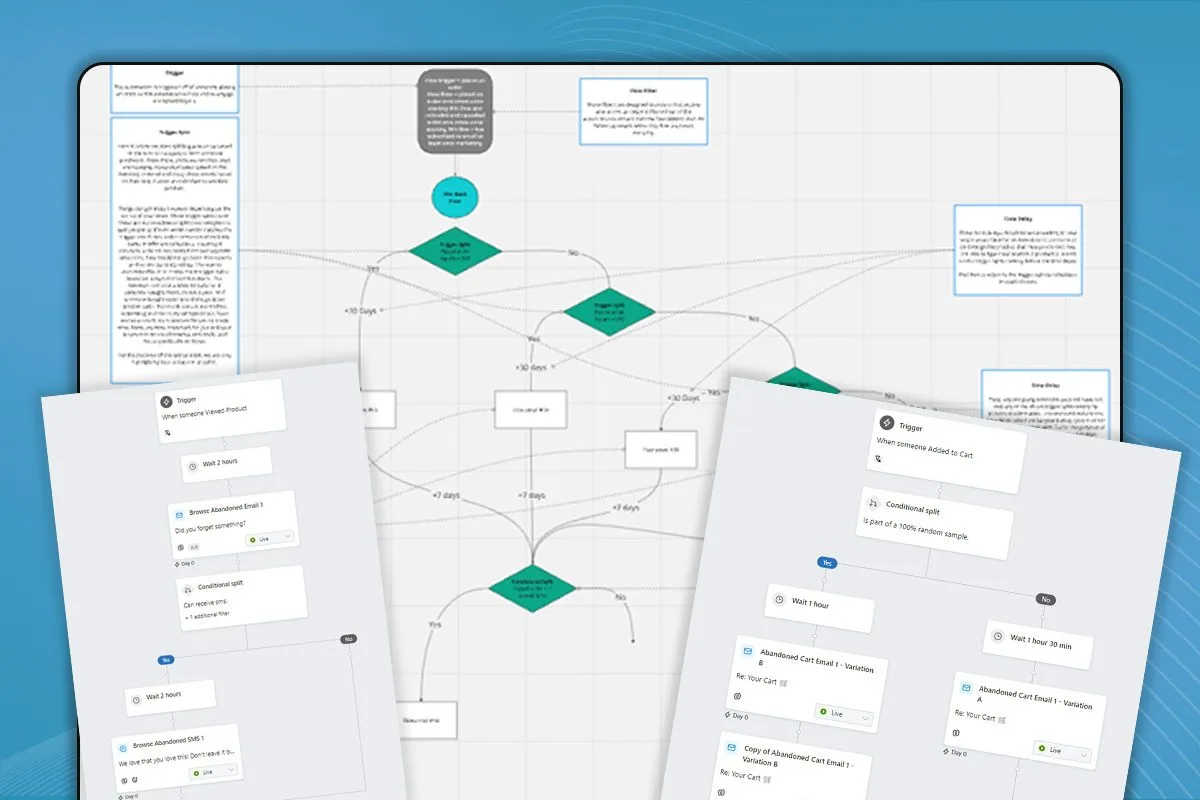
There are four abandonment flows, and they catch people at four different depths: they looked at the site, they looked at a product, they added to cart, or they started checkout. The deeper someone got, the stronger the intent and the more direct the flow can be. I walk through all four and how they fit together in The 4 Klaviyo Abandonment Flows Every Brand Needs.
Abandoned cart and checkout
Cart and checkout should be separate flows with separate triggers, because a checkout abandoner is much warmer than a cart abandoner and deserves a faster, more direct sequence. The structure, timing and filters are in How to Structure Klaviyo Abandoned Cart and Checkout Flows. Once they are running, How to Boost Your Cart Recovery Rate in Klaviyo covers the levers that lift recovery rate. For the copy, use How to Use ChatGPT Prompts for Abandoned Checkout Flows.
Browse abandonment
Browse abandonment is the softest of the four, so the tone should be helpful rather than pushy: here is what you looked at, here is what people pair it with, here is a review. Build it with How to Build a High-Converting Klaviyo Browse Abandonment Flow and script it with How to Use ChatGPT to Script Your Browse Abandon Flow.
Site abandonment
Site abandonment (sometimes called site bounce) catches known subscribers who visited but never reached a product page. It is low volume per person but adds up on busy stores. See How to Set Up a Klaviyo Site Abandon Flow That Converts.
Recovering more of the revenue you are already earning
A surprising amount of abandonment revenue is simply not attributed because tracking cookies expire. Two reads on fixing that: How Extended Pixel Tracking Recovers Lost Flow Revenue and How to Recover 10% More Flow Revenue with Better Tracking.
Post-purchase flows
The post-purchase flow is the one most brands underbuild. A thank-you email is not a flow. The job of post-purchase is to turn a first order into a second: set expectations about delivery, teach people how to use what they bought, ask for a review at the right moment, and introduce the next product when the timing makes sense.
Start with How to Build a Klaviyo Post-Purchase Flow That Drives Repeat Sales (Complete Guide). For the copy, there are prompts in How to Prompt ChatGPT for Post-Purchase Thank You Flows and How to Script Your Fulfilled Order Flow with AI.
Cross-sell and retention
Once the basic post-purchase flow is live, the next step is a cross-sell flow that recommends the right next product based on what someone bought. That is the flow behind How to Build a Klaviyo Flow That Boosts Retention by 57%. The bigger picture on retention is in How We Lifted Subscriber Retention by 105% in 12 Months.
Reviews
Review requests belong inside post-purchase, timed to land after the product has arrived and been used. For Google reviews specifically, see How to Build a High-Converting Klaviyo Google Review Flow. If you reward reviews with a code, How to Automatically Send Discount Codes After Reviews shows how to automate it, and How to Integrate Judge.me with Klaviyo the Right Way covers the integration.
Subscription brands
If you sell on subscription, the post-purchase job changes: the second order is already scheduled, so the flow is about preventing churn. See How to Build Post-Purchase Flows for Subscription Brands and How to Build High-Retention Recharge Flows in Klaviyo.
Win-back flows
A win-back flow targets customers who have bought before but have gone quiet for longer than your normal reorder cycle. The trigger timing matters more than the copy: too early and you are discounting people who were going to buy anyway, too late and they have forgotten you. Build it with How to Build a High-Converting Klaviyo Win-Back Flow, and script it with How to Use ChatGPT to Script Klaviyo Winback Flows.
Sunset flows
The sunset flow is the one nobody wants to build because it suppresses people rather than selling to them. It is also the flow that keeps your emails out of spam. Subscribers who have not opened or clicked in months drag down your sender reputation and inflate your Klaviyo bill. The sunset flow gives them a last chance to stay, then suppresses them. See How to Build a Klaviyo Sunset Flow That Protects Deliverability, and for the cost side, How to Lower Your Klaviyo Bill by Cleaning Unengaged Profiles.
Order and service flows
Beyond the six core flows there is a second tier that most stores should add once the basics are performing.
- Transactional emails (order confirmation, shipping, delivery) sent from Klaviyo so they match your brand and are tracked: How to Set Up Transactional Emails in Klaviyo, which also covers getting them approved.
- Cancelled and refunded order flows, which are both a service touchpoint and a feedback loop for product problems: How to Build Cancelled and Refunded Order Flows, How to Build a High-Converting Refunded Order Flow in Klaviyo and How to Fix Product Flaws Using Klaviyo Refunded Order Flows.
- Loyalty flows that remind people of points and rewards: How to Build High-Converting Loyalty Flows in Klaviyo, How to build a recurring loyalty points flow in Klaviyo and How to Display Live Loyalty Points in Klaviyo Emails.
- Wholesale flows if you sell B2B as well as direct: How You Should Build Wholesale Flows in Klaviyo.
- Discount automation so codes apply themselves at checkout: How to Auto-Apply Discount Codes in Klaviyo and Shopify.
Adding SMS to your flows
SMS does not need its own set of flows. It works best as an extra step inside the flows above, at the moments where speed matters: the first abandoned checkout touch, a delivery update, a flash reminder at the end of a welcome offer. Where to add it and where not to is covered in Where to add SMS into your Klaviyo automated flows, and the wider strategy in SMS Marketing in Klaviyo: How to Capture and Convert Leads.
Writing and designing flow emails
Every flow above has a ChatGPT prompt guide linked, and the overall approach is in How to Script Klaviyo Flows with ChatGPT Prompts. On format, not every flow email should be a designed template. Plain text often wins in post-purchase and win-back, where the email should feel like it came from a person. When to use which is in Plain text vs HTML emails: when to use each in Klaviyo.
Auditing flows that are already live
If your flows have been running for a year or more, assume some of them are broken: a filter that no longer matches, a product block pointing at a sold-out item, a split that sends everyone down one branch. I run through my audit process in How to Audit an 8-Figure Klaviyo Account Step by Step, and a faster version using AI in How to Audit Your Klaviyo Flows Using Claude. For reporting on flow performance and deliverability, see How to Build a Klaviyo Flow Deliverability Report.
Klaviyo has also reworked the flow builder itself. If you have not used it since the change, A Review of Klaviyo's New Flow Builder Interface covers what moved.
Where to start
If you are starting from nothing: build abandoned checkout this week, welcome next week, post-purchase the week after. Three flows, three weeks, and you will have covered the bulk of the revenue. Then work down the list. If you would rather we built them, our email automation service does exactly this, and you can see what it looks like for a real brand in our case studies.