What is an email marketing calendar?
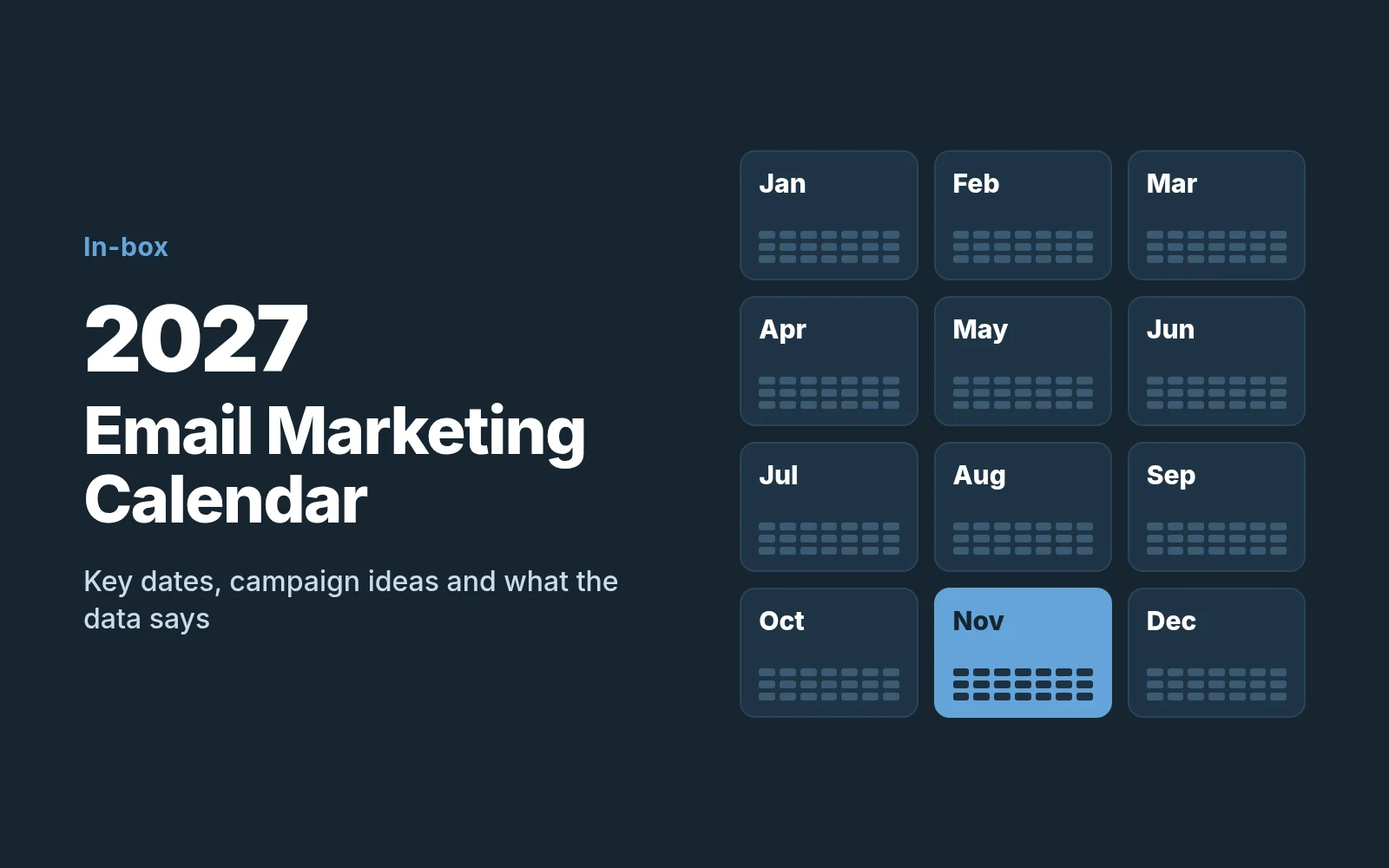
An email marketing calendar is a plan for which emails you will send and when to send them. That way, you build each email ahead of time instead of rushing to finish it the night before. This calendar covers all of 2027, month by month, and tells you how early to start each email. It also shows what we learned from the online stores we manage at In-box.
We read 13 monthly reports from 12 online stores. These stores sell jewelry, kids' clothing, skincare, supplements, shoes, collectibles, bed sheets, guitar accessories, RV parts, personalized gifts, spirits, and firearms accessories. Together, the reports cover 416 email sends and about 8.6 million emails and texts sent. Most stores only have one monthly report, usually from October 2026.
The results can still show us useful patterns, but they might not apply to every store or every month. The reports do not include January, December, or Black Friday week, so what we say about those is our best judgment.
Three things the data says before you plan a single date
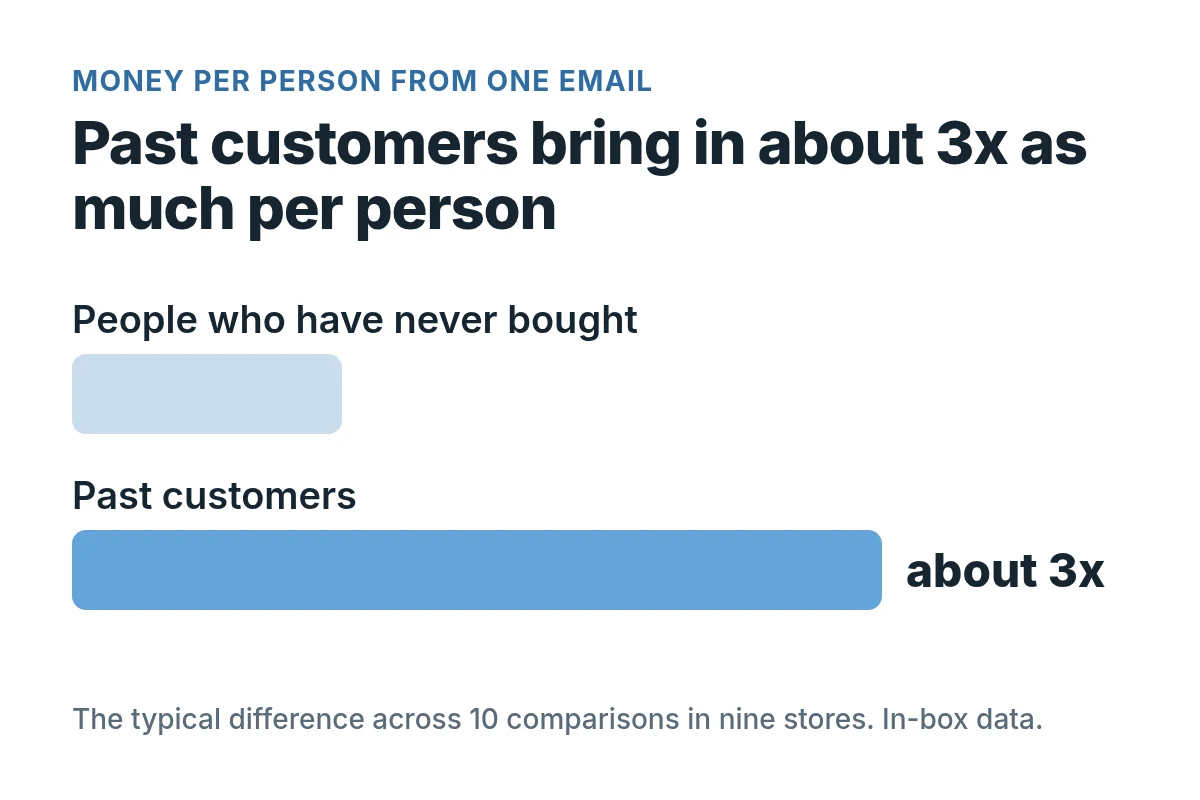
- Emails sent to past customers brought in about three times as much money per person as emails sent to people who had never bought. We compared the results 10 times across nine stores. Past customers brought in more money every time. The typical difference was about three times as much per person.
- Your best customers can be worth more than a much bigger email list. A supplements store gave 870 of its best customers early access to a sale. That email brought in $2.28 per person. Two days later, the public launch went to 37,460 people and brought in about one cent per person.
- Discounts didn't always lead to better results. Sale emails beat no-discount emails in five of eight stores we checked and lost in three. So don't assume you need a discount in every email. Test what works for your store.
For each big date below, create two versions of your email: one for past customers and one for people who haven't bought yet. Send one to engaged buyers (people who have bought and still open or click your emails) and one to engaged non-buyers (people who have never bought but still pay attention). Change the offer or the proof for each.
The 2027 calendar, month by month

These are US dates. "Start" tells you the day to begin working on the email.
January. New Year and fresh starts (January 1).
- Start in early December.
- Idea: a "new year, new routine" email, plus a thank-you to your best customers before anyone else hears about your January offer.
February. Valentine's Day (Sunday, February 14) and Presidents' Day (Monday, February 15).
- Start about three weeks ahead.
- Idea: a gift guide with one version for past customers and another for people who haven't bought yet.
March. Easter (Sunday, March 28).
- Start in early March.
- Idea: a spring refresh email, and an email before Easter that shows reviews and photos from happy customers.
April. Spring, tax-refund season and events that matter to your business.
- Start in mid-March.
- Idea: a "time to reorder" reminder for people who last bought about 60 to 90 days ago.
May. Mother's Day (Sunday, May 9) and Memorial Day (Monday, May 31).
- Start four weeks ahead for Mother's Day.
- Idea: a gift email with a clear "order by" date.
June. Father's Day (Sunday, June 20) and the start of summer.
- Start about three weeks ahead, in late May.
- Idea: a last-minute gift email that promises fast shipping, then a mid-year thank-you to customers who buy again and again.
July. Independence Day (Sunday, July 4) and summer sales in mid-July, including Amazon Prime Day if the dates line up.
- Start in early June.
- Idea: if you sell on Amazon, tell your list that your own site offers something Amazon does not.
August. Back to school and the end-of-summer sale.
- Start in early July.
- Idea: a "stock up" email to buyers and a "start here" email to non-buyers.
September. Labor Day (Monday, September 6) and the start of the fall launch season.
- Start in early August.
- Idea: an early-access email to your best customers 24 hours before the public launch.
October. Halloween (Sunday, October 31) and the start of holiday shopping.
- Start in early September.
- Idea: start building your Black Friday list now, including an early-access list.
November. Black Friday (Friday, November 26) and Cyber Monday (Monday, November 29).
- Start planning in September and build in October.
- Idea: early access for your best customers, then the public launch, then a closing email on the last day.
December. Holiday shipping deadlines (the shipping companies may not have shared their 2027 dates yet, so double-check them), Christmas and the end of the year.
- Start in early November.
- Idea: a "last day to order" email, then a "thank you, see you in the new year" email.
How sales should end
In October, a jewelry store ran an early Black Friday sale. Its two launch emails brought in $11,759 combined. The final email brought in $48,634, more than four times as much. It was the store's best campaign of the month.
A guitar accessories store ran three sales, and the middle email was the weakest one each time. A firearms accessories store went the other way: its launch beat its final-hours email. So the fair advice is to give the closing email as much care as the launch, and to make sure every email in the middle has a real reason to exist.
Your automatic emails earn more than most campaigns
Automatic emails are the ones that send themselves when someone does something, like joining your list or leaving something in their cart. Across the 13 reports, automated emails brought in anywhere from about 20% to 84% of email revenue. The typical share was around 47%.
In four of twelve stores, they earned more than all the regular campaigns put together. In 11 of the 12 stores, welcome emails brought in more money per person than the average campaign. So before you fill your calendar with campaigns, check that your welcome email and your "you left something in your cart" email are working.
What to be careful about
Sending more is not always better. One personalized gifts store sent 15,540 emails in September and 79,047 in October. Its email revenue rose by 701%, but its bounce rate (the share of emails rejected by mail servers) went from 0.60% to 2.32%. A jewelry store sent 23% more emails, and spam complaints increased 148%. Raise how much you send in small steps, and watch your complaints and bounces.
We also couldn't find one day of the week that worked best for every store. The best day was Wednesday in one store, Sunday in another, and Monday in the third. So test your own list instead of copying a rule.
Turn it into a sending schedule
- Write down your dates for each month, then pick two or three that fit your products.
- For each one, set a day to start building. Make it three to four weeks before the send.
- Split your list into two groups: past customers who still engage with your emails and people who engage but haven't bought yet. Decide what each group needs to see.
- Add an early-access email for your best customers on your biggest dates.
- Plan the closing email as carefully as the launch.
Our free 2027 email marketing calendar gives you a plan for the whole year, with 124 emails across 77 campaigns. It also shows you which customer groups to send each email to.
If you would rather have a team do it for you, In-box has done email marketing for more than 500 online stores.